
Every few weeks, a new headline warns that artificial intelligence is drinking the world's water and swallowing the grid. The concern is real. Data centres do use electricity. Many use water for cooling. Generative AI has made those buildings more power-hungry, more visible and more politically charged.
But there is a strange imbalance in the conversation.
We worry about asking an AI model a question, while ordering another size "just in case" barely registers. We debate whether a data centre should be built in a dry region, while wardrobes quietly fill with garments that required cotton fields, dye houses, finishing mills, ships, warehouses, delivery vans and return journeys. We can see the server farm on the news. We rarely see the river behind the T-shirt.
This article is not an argument that AI gets a free pass. It is an argument for perspective. If we are serious about sustainability, we need to compare the systems we criticise with the systems we use every day.

The uncomfortable question: are we more worried about the cloud because it feels new, or because the clothing supply chain has become invisible?
The headline numbers
Let's start with the cleanest available comparison.
According to the International Energy Agency's 2025 special report on energy and AI, global data centres used 415 terawatt-hours (TWh) of electricity in 2024. The IEA projects that figure could reach 945 TWh by 2030, with AI as the dominant growth driver. A terawatt-hour is one billion kilowatt-hours; 415 TWh is roughly 1.49 exajoules (EJ) of electricity.
Now compare that with fashion. The Global Fashion Agenda and McKinsey's Fashion on Climate analysis estimated that the global apparel industry used about 1,600 TWh of energy in 2019. That is roughly 5.76 EJ.
So, on energy alone:
- All global data centres in 2024: 415 TWh.
- Global apparel industry energy use in 2019: about 1,600 TWh.
- Apparel vs today's data centres: about 3.9 times more energy.
That comparison is deliberately conservative. It counts all data centres, not just AI-specific facilities, because the world does not yet have a clean public meter for "AI-only data centre electricity". In other words, 415 TWh is a generous upper boundary for today's AI infrastructure debate. Apparel still comes out nearly four times larger.
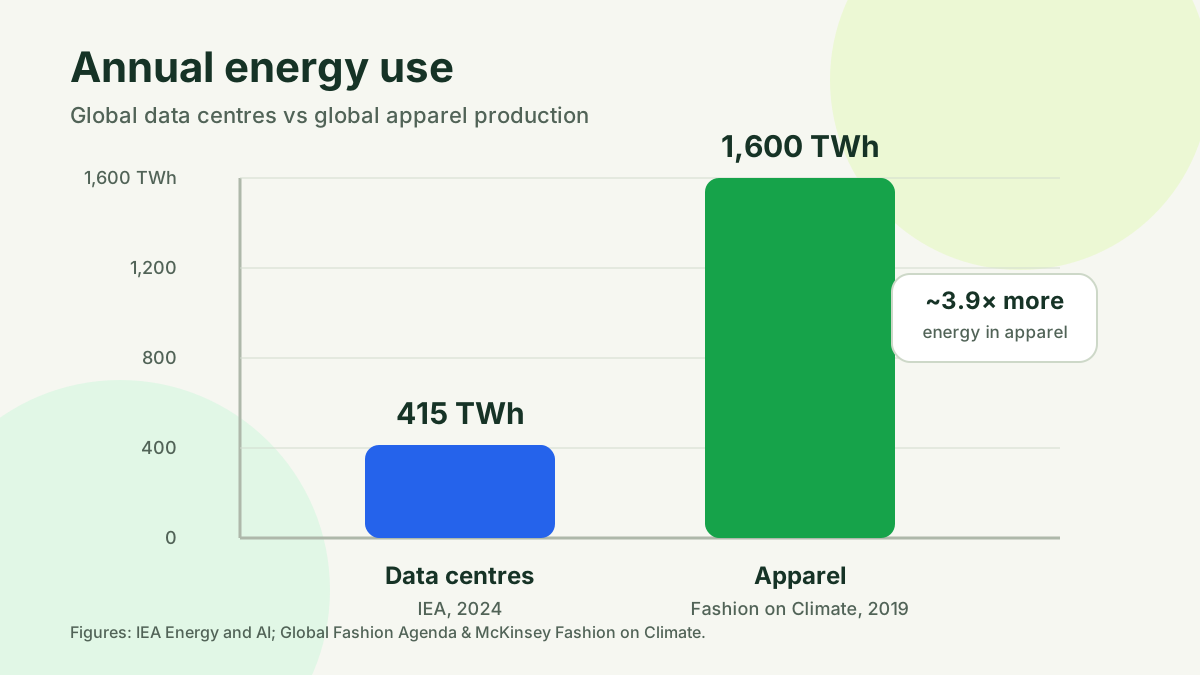
The energy difference is easier to see as a chart: apparel's estimated 1,600 TWh footprint is nearly four times the 2024 electricity use of all global data centres.
Water is where the comparison becomes startling
Water is harder to compare because every sector reports it differently. Data centre water use is often split between direct water consumed for cooling and indirect water associated with electricity generation. Fashion water use includes irrigation for crops such as cotton, processing, dyeing, finishing and washing.
Even with that caveat, the gap is enormous.
Bluefield Research estimated global operational data centre water consumption at 292 million gallons per day in 2022. Converted to metric units, that is about 1.1 million cubic metres per day, or roughly 404 million cubic metres per year. Bluefield projected this could rise to about 450 million gallons per day by 2025, around 620 million cubic metres per year.
Now compare textiles. The Ellen MacArthur Foundation's A New Textiles Economy report states that textile production uses around 93 billion cubic metres of water every year.
So, for water:
- Global data centre operational water use in 2022: about 404 million cubic metres per year.
- Projected global data centre operational water use in 2025: about 620 million cubic metres per year.
- Global textile production water use: about 93 billion cubic metres per year.
- Textiles vs 2022 data centre operational water: about 230 times more water.
- Textiles vs projected 2025 data centre operational water: about 150 times more water.
That is not a rounding error. It is a different order of magnitude.
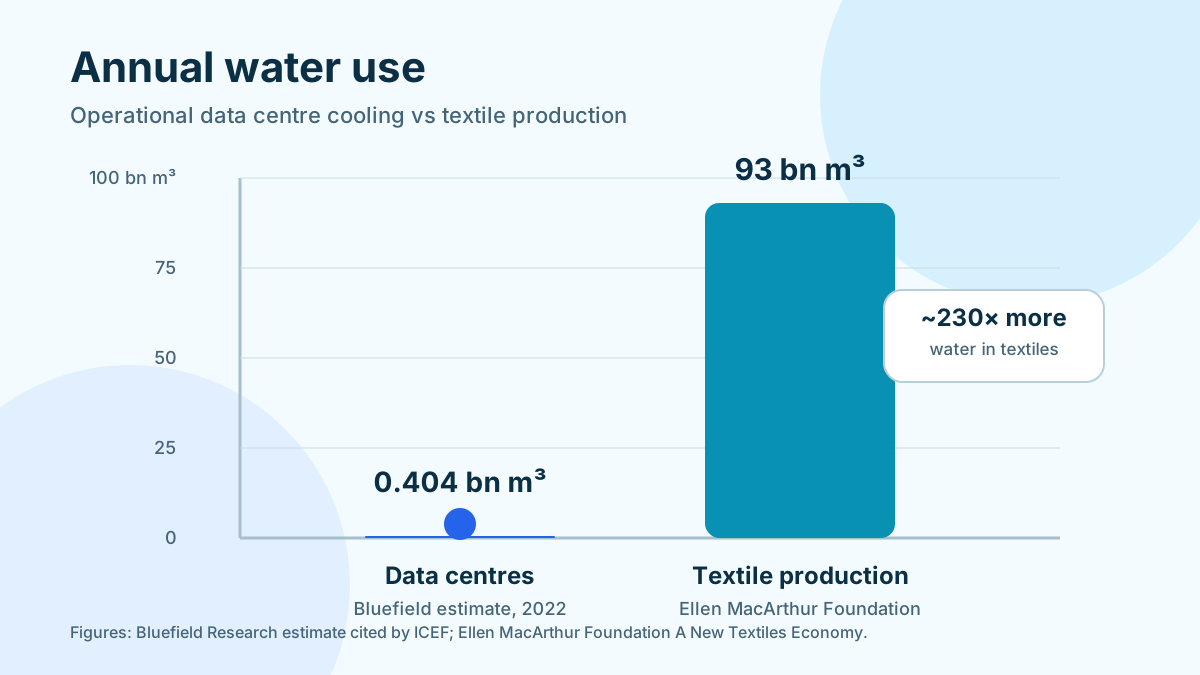
Water is the most dramatic comparison: textile production's 93 billion cubic metres per year towers over the 2022 operational water estimate for global data centres.
What about AI-specific water projections?
The most quoted AI water study, Making AI Less Thirsty by Shaolei Ren and co-authors, estimated that global AI demand could be responsible for 4.2 to 6.6 billion cubic metres of water withdrawal by 2027. That figure includes direct cooling and indirect water withdrawals connected to power generation.
It is a big number. It deserves attention. It means AI infrastructure must be planned carefully, especially in water-stressed regions.
But even against this projected AI water withdrawal, textile production's 93 billion cubic metres per year is still about:
- 22 times larger than the low AI projection of 4.2 billion cubic metres.
- 14 times larger than the high AI projection of 6.6 billion cubic metres.
This is the paradox: AI's water demand is visible because it is new and concentrated. Fashion's water demand is larger, older and distributed across farms, mills and factories. One looks like a building. The other looks like a wardrobe.
What the exact figures cannot tell us
Numbers are powerful, but they can also flatten reality. A cubic metre of water used in a wet, water-rich region is not the same as a cubic metre withdrawn from a stressed aquifer. A kilowatt-hour from wind is not the same as a kilowatt-hour from coal. A durable jacket worn for ten years is not the same as a low-quality garment worn twice.
That means the comparison should not be read as a licence for careless AI growth. It should be read as a reminder that scale and context both matter. AI infrastructure needs cleaner power, better cooling, heat reuse, transparent reporting and strong local water rules. Fashion needs lower-impact fibres, cleaner dyeing, renewable heat, better demand planning and fewer products made only to become markdowns or returns.
The most interesting sustainability work happens where those two stories overlap. If an AI fit recommendation uses a small amount of compute but prevents thousands of mis-sized orders, its footprint should be judged against the avoided manufacturing, shipping, repackaging and liquidation impacts. The same is true for demand forecasting that prevents overproduction, or product data that helps customers buy the right item first time.
In other words, AI is not automatically sustainable. But AI applied to one of the world's most resource-intensive consumer supply chains can be part of the solution.
Why clothing is so resource hungry
A garment is a chain of energy and water decisions.
A cotton T-shirt starts with land, irrigation, fertiliser and harvesting. Polyester starts with fossil feedstocks and industrial chemistry. Yarn is spun. Fabric is knitted or woven. Dyeing and finishing heat huge volumes of water. Components are stitched. The product is packed, shipped, photographed, marketed, warehoused, picked, delivered and sometimes returned.
Footwear adds more complexity: multiple materials, adhesives, foams, rubber compounds, moulding, finishing and packaging. A single pair of shoes can cross borders several times before it reaches a customer.

The checkout button is the end of the shopping journey, but not the end of the environmental journey. Shipping, returns and resale failures all add to the footprint.
The Quantis Measuring Fashion study found that apparel and footwear were responsible for around 8% of global greenhouse gas emissions in 2016, close to 4 gigatonnes of CO2-equivalent. The same work highlighted that dyeing and finishing alone represented 36% of apparel greenhouse gas emissions, with yarn preparation at 28% and fibre production at 15%.
Those percentages matter because they show where the energy goes. The biggest impacts are not always in the final shop. They are often buried deep in wet processing, heat, steam and electricity used before the consumer ever sees the product.
The returns problem: fashion's hidden multiplier
Online fashion has another multiplier: uncertainty.
Customers often buy two or three sizes because size labels are inconsistent across brands. They return what does not fit. Retailers absorb the cost or dispose of stock that can no longer be sold as new. Reverse logistics adds transport emissions, packaging, warehouse handling and sometimes waste.
The environmental cost of a wrong size is not only the delivery van that comes back. It is the entire upstream footprint of an item that was made, dyed, packed and shipped without ever becoming useful.
Every avoidable return represents energy, water, packaging and transport that failed to create value for the customer.
This is where AI can be more than another energy user. Used well, AI can help reduce overproduction, reduce size uncertainty, cut returns and extend the useful life of products. A recommendation model that prevents a needless return has an environmental cost, but it can also prevent a much larger one.
The question is not "does AI use resources?" It does. The better question is "does this use of AI remove more waste than it creates?"
A fairer way to think about AI and sustainability
The public debate often treats technology as either clean or dirty. Reality is more useful than that.
An AI data centre powered by fossil electricity and cooled with scarce water in a drought-prone region is a problem. A fashion supply chain powered by coal, producing garments that are worn twice and returned once, is also a problem. The goal is not to pick a villain. The goal is to reduce avoidable waste wherever the numbers tell us it matters.
Here is the comparison in plain English:
-
Today's global data centres use a lot of electricity: 415 TWh in 2024.
-
Apparel uses much more energy: about 1,600 TWh, nearly 3.9 times the 2024 data centre figure.
-
Data centres use meaningful water for cooling: about 404 million cubic metres per year in 2022, rising toward 620 million cubic metres by 2025.
-
Textile production uses vastly more water: about 93 billion cubic metres per year, roughly 150 to 230 times the operational water use of global data centres depending on the data centre year used.
-
Even projected AI-related water withdrawal of 4.2 to 6.6 billion cubic metres by 2027 is still 14 to 22 times smaller than the textile water figure.
The opportunity is not to ignore AI's footprint. It is to apply AI where it can shrink a much bigger footprint.
The uncomfortable takeaway
AI data centres deserve scrutiny. They should be powered by cleaner electricity, built with water stewardship, measured transparently and located responsibly.
But if we are going to talk honestly about energy and water, clothing, textiles and footwear must be in the same conversation. The numbers are too large to ignore. Fashion's resource use is not a side note; it is one of the major material flows in the global economy.
That makes sizing technology, demand forecasting, smarter inventory and return prevention more than retail optimisations. They are sustainability interventions.
At onefit.ai, we believe better fit can mean fewer returns, less waste and more confidence for customers. The most sustainable product is not only the one made from better materials. It is the one that is bought once, fits first time and gets worn.
References
- International Energy Agency, Energy and AI — data centre electricity demand of 415 TWh in 2024 and 945 TWh projected for 2030.
- Data Center Dynamics summary of the IEA Energy and AI report — accessible summary of the IEA data centre electricity figures.
- Ellen MacArthur Foundation, A New Textiles Economy: Redesigning fashion's future — textile production water use of 93 billion cubic metres per year and wider textile resource impacts.
- Quantis, Measuring Fashion — apparel and footwear greenhouse gas impacts and life-cycle hotspots.
- Greenhouse Gas Protocol summary of Measuring Fashion — overview of the Quantis findings.
- Global Fashion Agenda and McKinsey, Fashion on Climate — apparel sector emissions and energy-related decarbonisation context, including the 2019 industry footprint.
- Shaolei Ren et al., Making AI Less Thirsty — projected AI-related water withdrawal of 4.2 to 6.6 billion cubic metres by 2027.
- ICEF data centre water use roadmap note — data centre operational water estimates citing Bluefield Research.